

The minor placenames of the townland of Cahergowan, Claregalway, Co. Galway
The townland of Cahergowan is located southwest of Claregalway Village and covers an area of approximately 841 acres. It is one of the larger townlands in the parish. Like the townlands of Pollaghrevagh and Cloon, the topography of Cahergowan comprises higher ground and better quality land to the south (37m OD at its highest point at Cnocán Lorgan), with low-lying wetlands and bog to the north (just 10 m OD around Bun na Riasc). In the 1830s, the Ordnance Survey Name Books note the townland as: ‘the property of Lord Clanmorris and under tillage, with the exception of some portions of rocky pasture. The townland is bounded on the east by the road from Galway to Tuam and it contains a large portion of bog on its west side. At its centre in the 19th century were two large villages, (Clochar and Cahergowan) and a great portion of its centre was subject to winter floods.
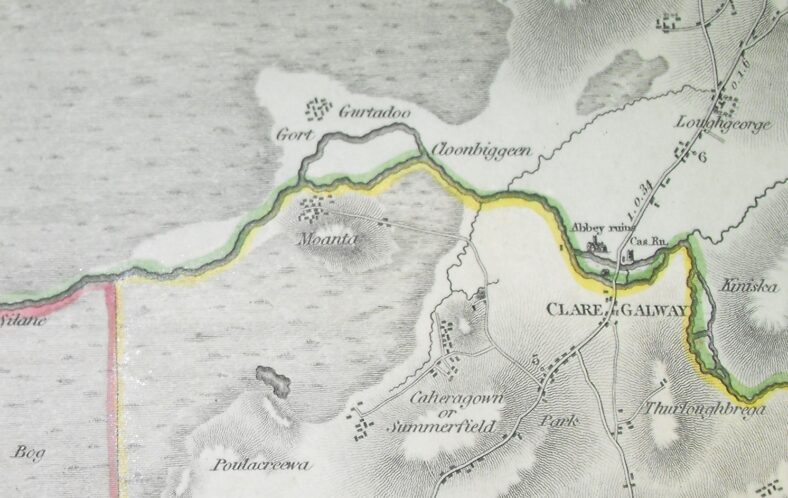
The Ordnance Survey recorded the name of this townland as ‘Cahergowan or Summerfield’ in 1838, although today, Summerfield is seldom used to identify the locality. The townland name is long-established, appearing the Books of Survey and Distribution in the 1670s as ‘Cargowne’, and on the Hiberniae Delineatio in 1685 as ‘Gortagowne’. Cahergowan has previously been interpreted by O’Donovan (1838) to mean ‘stone fort of the smith’. Writing some years ago in the Nuacht Chláir, Aodán Glynn considered the previous interpretations of the meaning of Cahergowan, offering a plausible alternative, that the name was derived from Cathair an Gabhain – fort of the calves (Glynn 2013, 4). We see also that a reference in the School’s Folklore Collection of the 1930s broadly agrees with Glynn’s interpretation: ‘Cathair Gabhann, mar bhí áit mór ann fadó agus bhíodh go leor beithidheach ann le h-aghaidh an bhaile’ – Cahir Gabhann, because there used to be a big place there and there used to be a lot of animals there for the village.
No provenance is given for the origin of the placename ‘Summerfield’, but a simple interpretation of this name is an area of ground that is used for pasture predominantly during the summer months. A large portion of the north of the townland is boggy, wet and subject to flooding during winter, and the name Summerfield reflects this. The name appears as ‘Summerville’ on Taylor and Skinners 1778 road map.
There were two significant settlement clusters (clacháns) recorded on Larkin’s 1819 Map of Galway and on the 1838 Ordnance Survey in the townland of Cahergowan, both located on the fringes of the bog. The first of these was at the end of what is known today as Clochar Road and comprised 26 buildings grouped around a network of small fields and bótharíns. However, the name Clochar is not recorded at this time and is not marked on a map until the time of the First Edition 25-inch Ordnance Survey in 1895. The second mid-19th century settlement cluster was located at Cahergowan Village and comprised approximately 55 buildings, again grouped around a network of small fields and bótharíns. Together with Montiagh and Gortcloonmore the settlements at Clochar and Cahergowan represent a distinctive settlement pattern comprising densely-packed villages on the fringe of the boglands. These settlement clusters were relatively densely populated areas on poorer quality land at the fringes of the wetlands and away from the estate lands of Rockwood and Rocklawn that had been established between 1812 and 1838.
Examining the First Edition 1838 map we can see that the network of local roads between these villages was unpaved and of a lower classification than in the neighbouring townlands of Cloon/Pollaghrevagh. We note also that no road connected the village at Clochar with Cloon at this time. This might suggest that settlement in Cloon was more recent than that in Cahergowan, and it seems likely that the straight line of Cloon Road, compared with the winding network of bótharíns in Cahergowan, was as a result of some degree of planning, likely related to the establishment of the Rockwood Estate with which Cloon Road aligns perfectly.
Our work in the townland identified 46 minor placenames and places of interest known locally. These placenames were collected by Mike Hession from Páraic Noone, Tomás Noone, Martin Flaherty and Gerry Cullinane. Included in this are numerous names provided by Clochar resident Phillip Cribbin who inherited a list of field names provided by his late brother-in-law Johnny Casserly who resided in Cahergowan. The placenames collected are frequently as Gaeilge and refer to fields, wells, houses, hills, bogs, gardens and other elements of the local landscape. Our placename survey in the townland of Cahergowan has identified numerous places of some considerable antiquity and importance, as discussed below.
There are a number of especially interesting placenames associated with the townland of Cahergowan. Most notable among them is a cluster of places and placenames that are associated with folk religion, folk religious practices, and ecclesiastical activities. These placenames appear to be concentrated between the Clochar and Cahergowan villages and include An Lisín (a Children’s Burial Ground), Báisín Pádraig (which appears to be a fine example of a bullaun stone) Páirc na hAltóra, which translates as the blessed field or altar field and is the site of a Mass Rock as well as Páirc na Mánaigh (the monk’s field) and Clochán an tSagairt (the priest’s stone or priest’s village). At Clochar we also find a forgotten holy well known as Tobar Mhuire/Tobar an Clochair/Tobar Mhaire Nóra – re-identified in this study through a reference in the Folklore Commissions Schools Collection. The placename Clochar itself can be translated as ‘convent’ though it has locally been understood to mean ‘stoney place’. Could this area be associated with ecclesiastical activity, perhaps during the Penal era of the 17th and 18th century?
In addition to evidence for folk religious practices we also find references to the natural landscape. Of course, there is Na Riasca (grassland prone to flooding), a placename which occurs throughout the parish. But also Cnocán Lorgan, a placename which refers to a “shin”-shaped hill or ridge (long, low and narrow), i.e. the higher ground across the southern parts of Cloon, Pollaghrevagh and Cahergowan where this placename also occurs.
The Ram Park and Carrowkeel are placenames that are known from the Tithe Applotment Books which were compiled between 1823 and 1837, though reference to Carrowkeel can be found as far back as the Books of Survey and Distribution in c.1674.
The memory of sporting prowess is also recorded in The Hurling Field (Garraidhe an Bháire’)located next to Hession’s old shop and pub. Also located here is Cloch Nirt [Neart], a reputed lifting stone/strength stone located at the corner of the building. It is believed that the last local man to lift the stone was Frank [Val] Duggan. It was recently revived as a traditional lifting stone by David Keohan.
This work is on-going. If you know of any other minor placenames in the parish of Claregalway that may be of interest, and you would like to contribute to our survey, please do get in touch.
| Map Reference | Name |
Notes |
| 1 | Poll na gCapall | The horse hole |
| 2 | An Leacach | The pavement/flagstones |
| 3 | An Lisín | A children’s burial ground known locally. |
| 4 | An Móinfhéar | Wavy hair-grass |
| 5 | An Pháirc Fhada | The long/far field. Recorded in the school’s folklore collection as: An gort fada. Tá an t-ainm air ar tá sé an-fhada. |
| 6 | Báisín Pádraig | A likely bullaun stone reputed to be a place where St. Patrick stopped and knelt to pray, and left the imprint of his knee. |
| 7 | Batty and Paddy Coady’s sand pit/Gort na claise | Batty and Paddy Coady’s sand pit – a place where sand was once extracted from. It is recorded in the school’s collection as: Gort na claise. Sin ainm atá ar pháirc a raibh clais ina mbíodh siad ag baint gainmhe ann. |
| 8 | Bótharín na [laca] leachta | The laneway of the headstone/monument, or possible that laneway of the pavement/flag stones |
| 9 | Bóithrín Pháirc na hAltóra | The laneway leading to the blessed field (where there is the mass rock) |
| 10 | Bun na Riasc | Bottom of the Fen |
| 11 | Carrowkeel | The placename Carrowkeel is marked on the First Edition 25-inch Ordnance Survey from the turn of the 20th century, but is in fact known from at least the mid-17th century and shown in the Books of Survey and Distribution. This is a long-established placename like meaning ‘’The Narrow Quarter’. It is also recorded in the school’s folklore collection: Ceathramha Caol, mar áit chaol atá ann |
| 12 | Clochán an tSagairt/Teach an tSagairt | The priest’s stone/village. It is recorded in the school’s collection: Clochán an tSagairt. Tugtar an tainm sin air mar tá bóithrín ann agus sin é an bealach a bhíodh ag an sagart le dul isteach ar an Móinteach. |
| 13 | Cnocán Draighin | The hill of the Blackthorn. It is recorded in the school’s folklore collection: Cnocán Droighnín [draighean]. Tá an tainm sin ar an áit sin mar go raibh sgeacha droighnín ag fás ann fadó. |
| 14 | Cnocán Lorgan | The top of the long, low ridge that is the highest point in the townland. This placename is also recorded in Pollaghrevagh. The name Lurgan is an anglicisation of the Irish name An Lorgain, literally meaning “the shin”, but within the context of placenames refers to a “shin”-shaped hill or ridge (i.e., long, low and narrow). i.e. the higher ground across the southern parts of Cloon, Pollaghrevagh and Cahergowan. |
| 15 | Commonage | An area of commonage |
| 16 | Commonage | An area of commonage |
| 17 | Cúinne na Sceach bóithrín | Corner/bend of the thornbush bóithrín – the precise location is unverified |
| 18 | Fr. Mannion’s House | Fr. Mannion’s House |
| 19 | Gallasses | Reputedly the name of two narrow fields in Cahergowan. The derivation is uncertain. |
| 20 | Hospital for black deaths | The reputed site of a hospital (possibly late medieval in date) |
| 21 | Johnny Casserly’s plots | Plots of good land set amongst bogland that once belonged to Johnny Casserly |
| 22 | Mass Path/Cosán an Aifrinn | A Mass Path |
| 23 | Mass Rock/Charraig an Aifrinn | A mass rock situated at Páirc na hAltóra |
| 24 | Na Riasca | The Fens (grassland prone to flooding) |
| 25 | Oileán an Droichid | Island of the bridge. The placename is noted in the school’s folklore collection: ‘Oileán an Droichid – mar tá droichid ann agus tá uisge thart air |
| 26 | Páirc Ainmhithe | The animal field |
| 27 | Páirc Daithí | David’s Field |
| 28 | Páirc na hAltóra | Interpretations of this term would include ‘Little field of the altar’ or ‘blessed little field’. A cluster of features at this location have folk-religious and ecclesiastical associations. |
| 29 | Páirc na Mánaigh | The monk’s field |
| 30 | Páircín na bPoill | Little field of the holes |
| 31 | The (Ram) Park/Páirc na Reithe | The (Ram) Park. Recorded in the school’s folklore collection: Páirc na Reithe, mar tá caorach ann. Also known from the Tithe Applotment Books. |
| 32 | The ball alley | A ball alley once stood here. It was demolished in the 2000s to allow for a widening of the river channel |
| 33 | Sliabh Chiamalta | A name found on a house at Cahergowan – It translates as ‘Keeper Hill’ or ‘The watching hill’. Antiquity is unverified. |
| 34 | Cúlán | Recorded as a house name in Cahergowan: Little nook; secluded, out-of-the-way, spot. Antiquity is unverified. |
| 35 | The Canal | A substantial drainage channel cut through this area of the bog. Arterial drainage schemes were commenced in 1842 |
| 36 | The Hurling Field/Garraidhe an Bháire’ | The field where hurling was played in Claregalway until the 1950s. Football was also played here in the 1960s. It is recorded in the school’s folklore collection: Garraidhe an Bháire, mar bhídís ag imirt báire ann fadó |
| 37 | The Nine Arches | The Nine Arches is the name of the now-disused bridge at Claregalway |
| 38 | Tobar Casbhaile | This translates as ‘the well on the homeward path’ |
| 39 | Tobar Cathair Ghabhain | Cahergowan Well |
| 40 | Tobar Mhuire/Tobar an Clochair/Tobar Mhaire Nora | This well is known by numerous names. It is located at the edge of the old clachán of Clochar. It is still extant though partially in-filled. During a visit here in the 1990s, steps leading down into the well were observed. The site is referred to in the Folklore Commissions Schools Collection as a holy well: Tobar Mhuire. Is tobar beannuighthe an tobar sin. Is i gClochar atá sé. |
| 41 | Tobar Pádraig | Pádraig’s Well |
| 42 | Tóin na Talún | The low ground. The land drops noticeably in elevation here |
| 43 | Tobar Mór | A roadside well first marked on the First Edition 25-inch Ordnance Survey (1895), and shown within an sub-circular enclosed area at the head of Cregboy road. The later settlement ‘Spring Mount’ is likely named after the well. It was likely used by those travelling on the Galway-Tuam road, as well as local residents. Local knowledge records that: ‘An Tobar Mór is located on the side of the Tuam-Galway road in the townland of Cahergowan, beside a house that was known as Sonny Kelly’s House. It has a circular wall at the rear and steps leading downwards towards the front. It supplied a plentiful supply of ice-cold drinking water. In later years, when the N17 (as it was known) was widened and raised, the well became contaminated by surface water from the road and the water was no longer fit for use. In the 1930s the well was the proposed site for a pump but it was decided to locate the pump in Cloon instead. It is recorded in the school’s folklore collection: Tobar Mór, mar tá tobar ann. |
| 44 | Tobar Well/Tobar an Baile | First appears on the First Edition 25-Ordnance Survey (1895) where it is marked as a circular well, this is one of three wells located in the village of Cahergowan; a densely populated clachán that has been in existence since before the publication of Larkin’s 1812 map. It is known locally as Tobar Well. No additional information was available at the time of the survey. |
| 45 | Cloch Nirt [Neart] | A reputed lifting stone/strength stone located outside Hession’s Shop/Pub. Another interpretation is that this is a kick stone for protecting the corner of the building. It is believed that the last local man to lift the stone was Frank [Val] Duggan. It was recently revived as a traditional lifting stone by David Keohan. |
| 46 | Garraí an Uisce | This is a tentative location for Garraí an Uisce. It is referred to in the school’s folklore collection: Garraí an Uisce – mar bíonn uisge ann sa nGeimhreadh |
No Comments
Add a comment about this page