

The minor placenames of the townlands of Curraghmore, Montiagh North and Montiagh South, Claregalway, Co. Galway
The townlands of Montiagh North, Montiagh South and the townland of Curraghmore are located to the very west of Claregalway parish, and with the exception of Montiagh Village, were very sparsely populated in the 19th and 20th centuries. A great deal of the land in these townlands comprises bog or reclaimed bog that is almost completely flat, low-lying, and prone to flooding from the River Clare which separates the townland of Montiagh South from Montiagh North and Curraghmore. At the time of Griffiths Valuation in the 1850s, there were no houses at all recorded in the townland of Montiagh North, just two houses in the townland of Curraghmore, but 43 houses in the townland of Montiagh South.
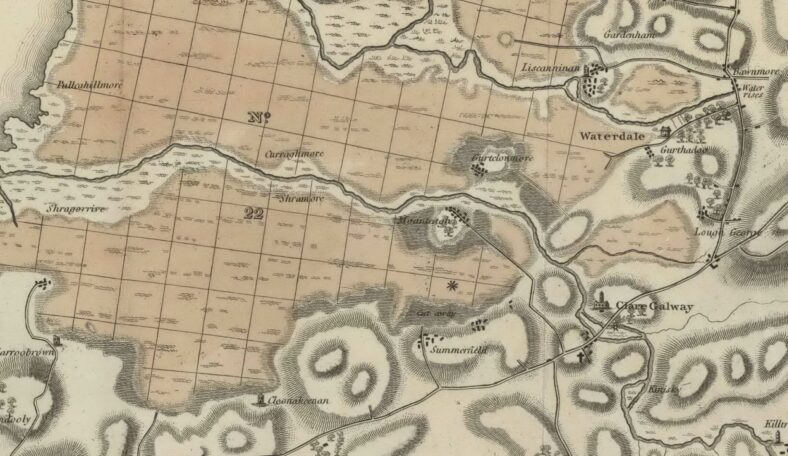
The 19th century village of Montiagh has been greatly defined by its relationship with the River Clare, and was really a small, low island or arable land surrounded by bog. This is easily visible in the Ordnance Survey maps of the 1830s which shows the clustered houses in the village that were only accessible via an unfenced trackway from Cahergowan, and which were frequently cut off from the rest of the parish during winter by flooding from the River Clare to the north. Trees lined the village to the southwest, to protect the settlement from the prevailing wind which crossed the uninterrupted expanse of bogland.
The townland of Curraghmore translates as The big Marsh and measures 792 acres in area. It borders Lough Corrib to the west. In the 1850s, just two houses were located in the whole townland. They belonged to families named Feeny and Burke, and the ruins of these houses can still be seen today not far from Curraghmore Bridge. Michael Burke held a herd-house, though it is difficult to know what amount of farming could have been done in the townland, given the boggy character of the land. Their houses are not recorded on the First Edition Ordnance Survey, and are only known to have existed around this time from Griffiths Valuation about two decades later. Consider too, how isolated this place must have been, located 1½ miles out into the bog before the construction of the Curraghline in the 1860s. The only real means of getting there must have been by boat along the Clare River.
The townlands of Montiagh North and Montiagh South are located west of the village of Claregalway on either side of the River Clare, and cover an area of approximately 454 acres and 331 acres respectively. At the time of the Ordnance Survey in the 1830s, both townlands are recorded together as ‘Montiagh’ in the Ordnance Survey Name Books, and are described as being ‘the property of Lord Clanmorris, 2/3ds. bog, the remainder under tillage and subject to winter floods’. At the time of this survey Montiagh is recorded locally as Mointeacha meaning ‘bogland’ although today, many people consider that Mointeacha is derived from Móin Teach, meaning the house or houses in the bog. It may even be a reference to the material that houses were built from here, with earthen cabins not being uncommon in many parts of Ireland up to and into the 19th century.
Our work in the townlands during 2021 identified 40 minor placenames and places of interest known locally. These are marked on the map below, and included in tabulated format. These placenames were collected by PJ Duggan from Sean Concannon. The placenames collected are almost entirely as Gaeilge, and refer to fields, wells, houses, canals, the River Clare, and other elements of the local landscape. The placenames collected often reflect the village’s close association with the River Clare and the impact of flooding on the area. Placenames like An Cé (The Quay), Oileán na Conáill (O’Connell’s Island) and Oileán na mBád (Island of the boats) refer to islands in the flood lands, and to navigation of the River Clare and the flood lands by boat. And of course, the placename Na Riasca is one which occurs frequently in the parish of Claregalway, and refers to land which is marsh, bogland or moor, which often floods. Particularly interesting in the village of Montiagh is the placename Bóthar na Bláth (the road of flowers).
| Map Reference | Townland | Name |
Notes |
| 392 | Curraghmore | Burke’s Walls | Burke’s House (Site of the former herd house) |
| 393 | Curraghmore | Curraghline | The Main Galway to Headford Road constructed in the 1860s |
| 394 | Curraghmore | Curraghmore Bridge | Curraghmore Bridge (built c.1970) – a tragedy occurred here on the earlier bridge c.1922/23 when a large hole appeared in the bridge. Three men from Claregalway (Quinn, Fahy and Clancy) fell through the bridge along with a pony and trap and were drowned. The pony swam to safety. |
| 395 | Curraghmore | Eanach | Swamp/Bog – High Bog, turf was never cut here – it is called Eanach. There are ponds or holes in the surface called ‘Caoghs’ that are dry in summer but dangerous in winter. |
| 396 | Curraghmore | Eanach | Swamp/Bog – High Bog, turf was never cut here – it is called Eanach. There are ponds or holes in the surface called ‘Caoghs’ that are dry in summer but dangerous in winter. |
| 397 | Curraghmore | Feeny’s Walls | The remains of Feeny’s House (still extant). They are believed to have left in the 1960s. |
| 398 | Curraghmore | Foslach | Swamp/Bog – Lower Bog where turf has been cut, it is called Foslach |
| 399 | Curraghmore | Foslach | Swamp/Bog – Lower Bog where turf has been cut, it is called Foslach |
| 400 | Montiagh South | An Baile Siar | The back village |
| 401 | Montiagh South | An Baile Thiar | The west/near village |
| 402 | Montiagh South | An Cé | The quay |
| 403 | Montiagh South | An Spoil bank | The Spoil Bank – material dredged from the River Clare and place on the riverbank. |
| 404 | Montiagh South | An Tuílínn | The little flooded area. |
| 405 | Montiagh South | Bárlán [brarlán] | Recorded in the Schools Folklore Collection: An brarlán. Sin áit in aice leis an abhainn a mbaintear móinfhéar agus ina mbíonn uisge sa ngeimhreadh. A place near the river where grass is harvested and where there is water in the winter |
| 406 | Montiagh South | Bearna Bhuí | The yellow gap |
| 407 | Montiagh South | Bóthar an Ualtar (Walter) | Walter’s Road |
| 408 | Montiagh South | Bóthar na Bláth | The road of flowers |
| 409 | Montiagh South | Bun na Claí | Bottom of the ditch |
| 410 | Montiagh South | Calla an tSileán | The strip of the trickling water |
| 411 | Montiagh South | Calla nua | The new strip |
| 412 | Montiagh South | Garraí Beag | The little garden |
| 413 | Montiagh South | Garraí Ciannaigh | Kenny’s Garden |
| 414 | Montiagh South | Garraí na Móna | The bog garden. It is recorded in the school’s folklore collection: Garrdha na Móna. Sin garrdha atá in aice na móna. |
| 415 | Montiagh South | Léana | Low-lying grassy place, water-meadow |
| 416 | Montiagh South | Mullach an Ghort | The mound/hump of the field |
| 417 | Montiagh South | Na Clocha Móra | The big stone |
| 418 | Montiagh South | Na Riasca | The Fen |
| 419 | Montiagh South | Oileán na mBád | Island of the boats. It is recorded in the school’s folklore collection: Oileán na mbád. Sin áit a mbíonn móinfhéar ann in aice na h-abhann |
| 420 | Montiagh South | Ritheann abhainn an Clár idir Móinteach thuadh and Móinteach Theas | The course of the River Clare |
| 421 | Montiagh South | Scearraigh | A reef or rocky island. |
| 422 | Montiagh South | Sramore | It derives from srath mór which translates to the big holm or river-meadow |
| 423 | Montiagh South | Sruth Buí | The yellow stream or sward [sraith] |
| 424 | Montiagh South | Tobar Cuilín | The well in the little place behind/at the back |
| 425 | Montiagh North | An Móinear Beag | The little bog meadow |
| 426 | Montiagh North | An Móinear Mór | The great bog meadow |
| 427 | Montiagh North | An Sraith | The spreading ground/swath/ a strip of land by a river |
| 428 | Montiagh North | Bisceán | Buí uiscean – yellow water[1] |
| 429 | Montiagh North | Oileán Fadá | The far away island – It is recorded in the school’s folklore collection: Oileán Fada. Oileán atá an-fhada síor ón mbaile. |
| 430 | Montiagh North | Oileán na Conáill | O’Connell’s Island |
| 431 | Montiagh North | Tabhairn Beag | The little cut-off place [tamhain] |
| 432 | Montiagh North | Tabhairn Mór | The great cut-off place [tamhain] |
[1] An interpretation kindly offered by Luke Concannon
Comments about this page
My grandaunt Kathleen Feeney was the last resident of Curraghmore. She’s in her 90s now she left in the 80s. Her father made the crib for babies out of barrels that when the bad floods came during the night the baby would be safe and float. Sometime in the 30s or 40s a new house was built further away from the river. When my grandmother was a child they would collect sloes and berries from the bog.
some names are slightly lost
in the phoenetics ;biscean =bui uiscean = yellow water ;I think tobar an culín should be Cúl linn =back pool ;my observations are based on some books I studied in the past ;;note here a place called ;;an straith ;; this meaning a strip of land by a river ;still used in England STRATford on Avon ;even here Avon =Abhann =river;
Add a comment about this page